FiFNA Statements
Below are Forward in Faith statements that I am aware of.
- 1999 Agreed Statement on Communion
- 2010 Declaration
- 2013 Declaration
- 2017 Declaration
- 2024 Declaration
Forward in Faith North America recently walked back its affirmation of the seven councils. While not intentional, it does provide for one to contextualize any of the seven “Insofar as they are agreeable to scriptures,” thereby casting a negative light on the councils themselves.
One of the core attributes of the Anglican way is that everything must be founded upon scripture, as in FiFNA declaration #2, so such language frames that the ecumenical councils are under the knife of Article XXI: that the seven have erred somewhere (which ones? In what way?), not just Roman councils that precipitated (Lateran 1215) the English break with Rome, or those councils that came after (Trent & Vatican I).
Article XXI is more precise: “things ordained by [general councils] as necessary to salvation have neither strength nor authority, unless it may be declared that they be taken out of Holy Scripture,” just "insofar as they are agreeable to the scriptures." This in many ways is a better appeal: that, as affirmed univocally in the Anglican tradition, matters of salvation are those which are provable in and by scripture. If it is primarily the Seventh (Nicaea II ,for which there is justifiable precedent to have caution), then it would be better to revise an affirmation of only the first six, or else four, or else remove the statement, than cast doubt on the conclusions of all of them.
As far as how this shapes implicit common ground with other continuing & non-papal catholic groups:
The Affirmation of St Louis (Continuum founding document) states,
"The received Tradition of the Church and its teachings as set forth by 'the ancient catholic bishops and doctors,' and especially as defined by the Seven Oecumenical Councils of the undivided Church, to the exclusion of all errors ancient and modem,
And the Union of Scranton states,
"The Union of Scranton confesses the Catholic faith as articulated by the first seven Ecumenical Councils and expressed throughout the Undivided Church.”
Neither of which have a qualifier.
This change means that the talk by Met Jonah in 2009, and 2012, presenting the pathway to full communion with the Orthodox, has been left behind by FiFNA:
- reject Calvinism
- reject WO
- affirm seven sacraments
- affirm seven councils
FiFNA was the only coalition in ACNA that affirmed all points, perhaps in response to Met Jonah's overtures at the time; not any more.
True, one can maintain belief as before, however, but it seems to negate the need to include a point affirming the councils at all, since ACNA1 & others already do so in this way elsewhere, and with more precision.
ACNA’s declaration is excellent: balancing Anglican reserve alongside the Old Catholic expectation of the seven. Neither Eastern Orthodox nor Roman Catholic affirm the seven in the way that Continuing and Old Catholic churches confess.
Prior to the mid 20th century ecumenism with Old Catholic Churches, Anglo-Catholics upheld the four (following Bishop Andrewes), plus generally up to the sixth (C.B. Moss, below), without much mention of the seventh. So, rightly, there is room for nuance over the seventh, but not to the implicit denigration of the first four or six.
Again, Since FiFNA does not need a statement about the councils (first instance of such is in 2013), and both ACNA and Affirmation of St Louis have their own affirmation of the councils, then it might be better to remove the statement altogether, or else have an unqualified affirmation of the first-sixth, following Moss.
To that end, Moss writes:
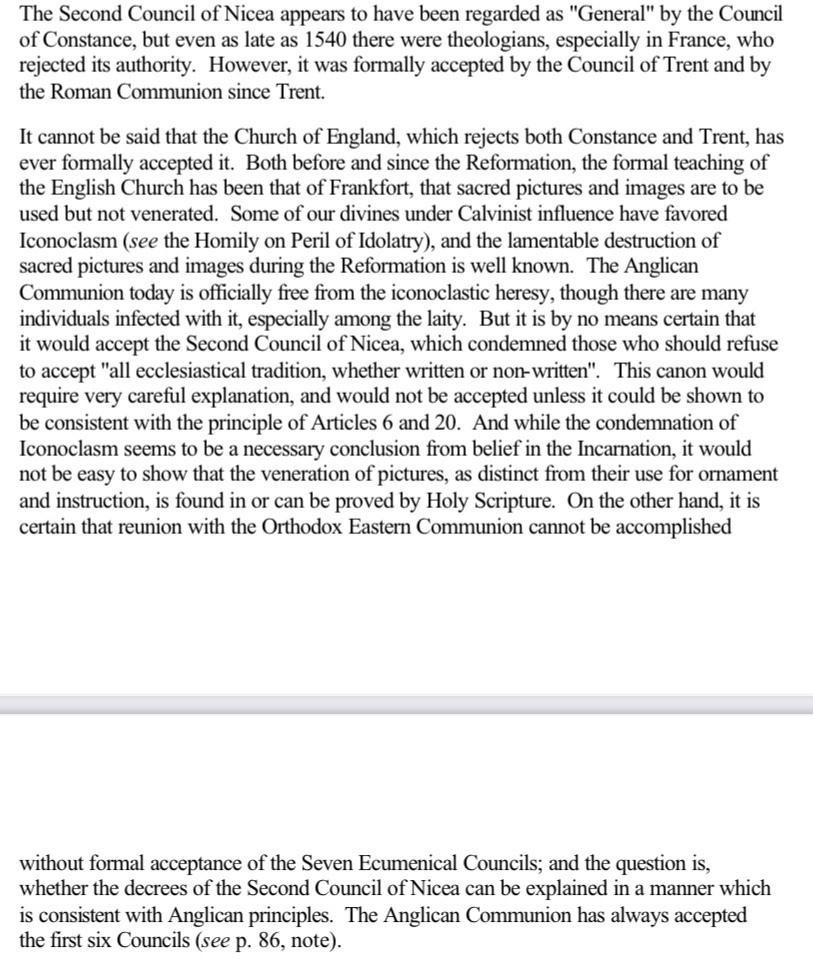
ιμκ
The ACNA Fundamental Declarations has a more precise, more broad, and less suspicious affirmation:
Concerning the seven Councils of the undivided Church, we affirm the teaching of the first four Councils and the Christo-logical clarifications of the fifth, sixth and seventh Councils, in so far as they are agreeable to the Holy Scriptures.
↩